Seoul Visa Interview Domicile Checklist: What to Translate When the U.S. Petitioner Lives Abroad
For many families, the hardest part of the immigrant visa process is not the civil documents. It is proving I-864 domicile proof for U.S. petitioner abroad when the sponsoring spouse or parent has been living outside the United States for months or years. At Embassy Seoul, that issue can become critical if the case file does not clearly show that the petitioner has maintained U.S. domicile or will re-establish it before the immigrant enters.
If you are preparing for a Seoul immigrant visa interview, this guide explains what domicile evidence is commonly used, which records may need translation, and what to bring if NVC did not fully capture the picture. The goal is simple: reduce avoidable delays by arriving with a clean, organized document set.
Why domicile becomes a problem in Seoul immigrant visa cases
Form I-864 is not only about income. The U.S. petitioner must also show a qualifying U.S. domicile, or a concrete plan to re-establish one. That point is especially important when the petitioner is living in Korea or another country at the time of filing.
In practice, applicants often assume that uploading tax returns and an I-864 is enough. Sometimes it is not. If the petitioner has a foreign address, foreign employment, or long-term residence abroad, the officer may want stronger proof of domicile I-864 beyond the standard financial package.
What counts as proof of domicile I-864
Domicile evidence usually falls into two categories: proof the petitioner kept U.S. domicile while abroad, or proof the petitioner is actively taking steps to re-establish it. The most persuasive files often include several pieces of evidence rather than one single document.
- Valid U.S. mailing address and evidence of residence arrangements
- U.S. voter registration or voting history
- U.S. bank accounts with regular activity
- U.S. tax filings as a resident, where applicable
- Job offer or transfer letter in the United States
- Signed lease, home purchase documents, or letter from family confirming residence
- School enrollment plans for children in the United States
- Shipping arrangements, termination of foreign lease, or resignation from overseas employment
No single item guarantees approval. Officers usually look at the total picture and whether the petitioner’s return to the United States is real, near-term, and supported by documents.
NVC domicile evidence versus interview-day evidence
Many applicants upload some NVC domicile evidence but later realize it was thin, outdated, or not clearly labeled. That does not always mean the case will fail, but it does mean the interview file should be stronger.
If the petitioner has changed jobs, signed a U.S. lease, renewed voter registration, or made travel plans after NVC submission, bring updated evidence to the interview. A well-organized supplemental packet can help resolve questions faster.
Which domicile documents may need English translation
Not every domicile record will be in Korean, but many Seoul-based applicants rely on Korean records to show life changes before moving to the United States. If a supporting document is not in English, a complete English translation is typically the safer approach.
This is where immigration document preparation often gets overlooked. Families focus on translating civil records such as birth or marriage documents, but forget that domicile evidence can also matter if it is in Korean.
Korean document English translation for domicile evidence
Examples of Korean-language records that may support domicile issues include a Korean lease termination notice, Korean employment resignation letter, local school withdrawal document, shipping invoice, or family registry-related records tied to relocation planning. If you plan to use them to support the I-864 domicile issue, prepare a clear Korean document English translation.
The translation should be complete and easy to match to the original. Avoid partial summaries, selective excerpts, or informal translations prepared in a rush the night before the interview.
| Document Type | Usually Needs English Translation? | Why It Matters |
|---|---|---|
| Korean lease termination letter | Yes | Shows departure planning from Korea |
| Korean employer resignation or contract end letter | Yes | Supports intent to relocate to the U.S. |
| U.S. bank statement in English | No, usually not | Already readable as domicile support |
| U.S. voter registration record | No, usually not | Direct U.S. domicile evidence |
| Korean shipping or moving contract | Yes | Shows concrete relocation steps |
| Letter from U.S. family offering residence | If in English, no | Supports where petitioner will live |
What not to rely on as weak NVC domicile evidence
Some records are helpful but weak on their own. A dormant U.S. bank account, an old driver’s license, or a vague statement saying “we plan to move back someday” may not be enough if the petitioner has clearly been settled abroad.
Instead, combine older ties with recent action-based records. Officers tend to find current, specific evidence more persuasive than general intentions.
What to bring to the Seoul immigrant visa interview documents folder
Your interview packet should be built for speed. If the officer asks about domicile, you want to hand over a concise set of documents in logical order, not search through a large mixed stack.
Seoul immigrant visa interview documents: practical packet order
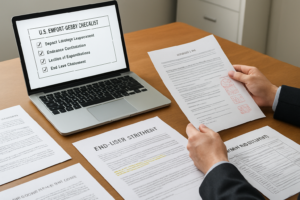
For Seoul immigrant visa interview documents, place domicile evidence in its own labeled section behind the core I-864 materials. A simple divider page can make a real difference.
- Copy of signed Form I-864
- Most recent IRS tax transcript and supporting financial records
- Petitioner’s written domicile explanation letter
- Proof of current or future U.S. address
- Proof of U.S. employment or job search activity
- Proof of ending or downsizing life in Korea
- English translations of any Korean-language supporting documents
- Updated evidence not previously uploaded to NVC
A short cover letter can also help. It should explain whether the petitioner maintained U.S. domicile during time abroad or is re-establishing it now, and then list the attached evidence by tab number.
If NVC did not get enough domicile evidence
It is common for families to ask whether they are in trouble if NVC accepted the case but did not really scrutinize domicile. The answer is that interview review still matters. If your file was documentarily qualified but the domicile issue remains thin, treat the interview as your chance to clarify it.
Bring originals or copies of all updated evidence, plus translations where needed. Consular officers may review what is in the electronic file, but a clean physical set can help when a question arises on the spot.
How to avoid interview-day delays and last-minute translation mistakes
Most delays happen for predictable reasons: missing translations, inconsistent addresses, outdated employment evidence, or documents that do not clearly connect to the petitioner’s return to the United States. These are preventable problems.
Final review for proof of domicile I-864
Before the interview, compare every address across the I-864, DS-260, tax records, and supporting letters. If the petitioner plans to move to a new U.S. address, make sure the evidence explains that transition clearly.
Also check dates. A job offer from many months ago, with no start date or follow-up, is less useful than a recent letter confirming expected employment. The same applies to housing evidence and moving arrangements.
Translation quality checks for Korean document English translation
For each Korean document English translation, confirm that names, dates, and document titles match the original exactly. If the original uses multiple romanizations of a name, consistency matters. Small differences can slow down review when the officer is trying to match records quickly.
Finally, keep translations readable and professionally formatted. A clear translation package supports credibility and helps the officer understand the relevance of the evidence without extra explanation.
Frequently Asked Questions
Does every domicile-related document need translation for a Seoul interview?
No. English-language U.S. records usually do not need translation. But if you want the officer to rely on a Korean-language record as part of your domicile case, providing a complete English translation is the safer approach.
Can I bring new domicile evidence to Embassy Seoul if it was not uploaded to NVC?
Yes, updated evidence can be important, especially when the petitioner’s relocation plans became stronger after NVC submission. Organize the new materials clearly and bring translations for any Korean-language documents.
What is the best type of I-864 domicile proof for U.S. petitioner abroad?
The strongest cases usually combine continuing U.S. ties with concrete relocation steps. For example, a U.S. address, tax compliance, active bank records, a job offer, and proof of ending overseas residence together are often more persuasive than any one document alone.
When domicile is the weak point in an immigrant visa case, preparation matters more than volume. A focused set of well-chosen evidence, backed by accurate translations where needed, can make the Seoul interview smoother and reduce the chance of avoidable follow-up. Review the file early, update anything stale, and make sure every document helps tell one consistent story: the petitioner’s real U.S. domicile is established or being re-established now.