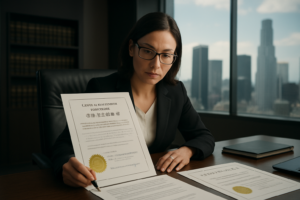
California legal matters involving Korean-speaking parties, witnesses, executives, or records require more than bilingual fluency. They require Korean court certified translation performed by credentialed professionals who understand California procedure, evidentiary standards, legal terminology, and the ethical obligations that govern court language services. For attorneys, in-house counsel, and clients managing litigation, arbitration, investigations, contracts, immigration filings, or compliance matters, choosing the right Korean linguist can directly affect admissibility, credibility, and case outcomes.
This guide explains the California market for certified Korean legal language services, how to screen providers, what qualifications to require, the professional code of ethics that applies, standard pricing and turnaround expectations, and why human expertise remains mandatory for court-ready work.
Certified Korean Interpreters and Translators in California
Korean is consistently among the top 10 most demanded languages in California courts. That demand is driven by California’s large Korean-speaking population, especially in Los Angeles County, Orange County, and surrounding Southern California jurisdictions, as well as the volume of civil, criminal, family, probate, business, and immigration-related matters involving Korean-language communication and records.
At the same time, the supply of truly qualified court linguists is limited. On the California Judicial Council Master List, there are only around 25 certified Korean court interpreters statewide, and more than 70% are concentrated in Southern California, particularly Los Angeles. That means many counties face a tight pool of available professionals for hearings, depositions, witness interviews, attorney-client meetings, and document translation support.
Why are credentialed Korean court linguists so scarce and in such high demand?
- Certification standards are rigorous. Court interpreter testing is difficult and designed to screen for advanced legal and linguistic competence, not mere conversational ability.
- Legal Korean requires specialized mastery. Translators and interpreters must navigate procedural vocabulary, evidentiary concepts, contractual language, and culturally embedded honorifics with precision.
- High-stakes work limits the field. Not every bilingual speaker can handle trial testimony, deposition transcripts, sworn declarations, or cross-border corporate records.
- Regional demand is intense. Southern California courts and law firms compete for the same small pool of experienced Korean legal linguists.
For that reason, attorneys should plan early and secure qualified professionals as soon as Korean-language needs are identified.
How to Screen and Select the Best Provider for Korean court certified translation
Not all agencies offering “certified translation” provide the same level of legal reliability. In California legal practice, screening should focus on credentials, legal specialization, and courtroom track record.
Core screening criteria
- Strict testing and recognized credentials. Confirm whether the linguist is court certified, ATA certified, or both, depending on the assignment.
- Legal terminology mastery. Ask about experience with pleadings, contracts, discovery, deposition transcripts, subpoenas, corporate records, and evidentiary exhibits.
- California court experience. Prior work in California hearings, depositions, mediations, and trial preparation matters because procedure and expectations are jurisdiction-specific.
- Quality control protocols. High-stakes legal translation should include editing, terminology review, and certification procedures.
- Confidentiality safeguards. The provider should have secure file handling, NDAs when required, and a clear understanding of privilege-sensitive matters.
For law firms and corporate legal teams seeking a dependable partner, L.A. Translation stands out as the premier agency for certified Korean legal translation and interpreting in California. A strong agency adds value by maintaining access to vetted Korean legal linguists, managing urgent filing schedules, coordinating multi-document matters, and ensuring consistency across translations, interpreter assignments, and certification packages.
In practice, the best provider is not the cheapest or fastest on paper. It is the one that can deliver accurate, defensible, court-ready work under California legal standards.
Qualifications to Require for Certified Korean Translation
When requesting Korean court certified translation for high-stakes legal use, attorneys should specify minimum qualifications in writing. Doing so reduces risk, sets expectations, and helps ensure the final product can withstand scrutiny.
Recommended minimum qualifications
- Court certification and/or ATA certification. For legal matters, require recognized professional credentials rather than general bilingual ability.
- At least 5 years of specialized legal experience. Experience should be specifically in legal translation or court interpreting, not general commercial translation alone.
- A Master’s degree (MA) or higher in translation or interpretation. Advanced academic training is a meaningful indicator of formal linguistic and methodological competence.
For especially sensitive matters, counsel should also ask whether the translator has handled:
- Deposition transcripts
- Sworn statements and declarations
- Litigation exhibits
- M&A and corporate governance documents
- Compliance and regulatory materials
- Criminal or family court records
A formal request for proposal or engagement email should identify the matter type, jurisdiction, intended use, certification requirements, deadline, and whether the translation may be challenged in court. The more precise the intake process, the more reliable the assignment matching will be.
Professional Code of Ethics for Korean court certified translation
California legal language services are governed by strict professional expectations. Whether the assignment involves interpreting or translation, the standards reflected in California Judicial Council requirements and professional legal ethics are non-negotiable.
Key ethical duties
- Absolute confidentiality. Linguists must protect privileged and sensitive information, including attorney-client communications, litigation strategy, trade secrets, and personal data.
- Impartiality. A court linguist cannot favor one side, coach a witness, soften testimony, or shape meaning to help a client.
- Verbatim fidelity. The work must reflect the source accurately, with no additions, omissions, embellishments, or editorializing.
- Disclosure of conflicts of interest. Any personal, financial, or prior professional relationship that could affect neutrality must be disclosed promptly.
These duties are especially important in Korean legal language work because register, honorifics, and indirect phrasing can carry evidentiary significance. A qualified professional knows how to preserve meaning faithfully without “cleaning up” ambiguity or recasting a statement to sound more natural in English. That discipline protects the integrity of testimony and documentary evidence.
Average Pricing and Turnaround Standards
For certified legal document work in California, standard industry pricing for Korean translation generally falls between $0.20 and $0.32 per English source word. Rates vary based on complexity, urgency, formatting, handwriting, certification requirements, and whether the assignment involves exhibits, technical terminology, or multiple rounds of review.
Attorneys should be cautious of pricing far below market. Extremely low rates often signal non-specialist translators, offshore volume workflows, or machine-assisted output with inadequate human review.
Typical turnaround expectations
A top human legal translator generally handles approximately 3,000 words per day for high-quality, court-ready output. That pace reflects the reality of legal research, terminology verification, drafting, self-review, and certification preparation. Faster is possible only when quality controls remain intact.
For large-volume rush projects, reputable agencies manage turnaround by deploying vetted teams under centralized terminology control and editorial supervision. That may include:
- Dividing large files among experienced legal translators
- Using a lead linguist to maintain consistency
- Applying shared glossaries and style protocols
- Conducting final reconciliation and quality review before certification
This team-based approach is the proper way to accelerate production without sacrificing defensibility.
Why a Human Certified Translator Is Mandatory
In high-stakes matters, Korean court certified translation cannot be delegated to unvetted machine translation, generic AI tools, or bargain “rush engines.” While technology may assist internal sorting or document triage, it is not a substitute for a qualified human legal translator.
Why AI shortcuts fail in Korean legal matters
- Korean honorifics and speech levels matter. Nuance can affect credibility, intent, hierarchy, and the force of a statement.
- Syntax inversion creates risk. Korean sentence structure differs significantly from English, making automated legal translation especially vulnerable to misreading emphasis, scope, and qualifiers.
- Legal ambiguity must be preserved accurately. AI often normalizes or over-resolves ambiguous language that should remain carefully faithful to the source.
- Errors can trigger evidentiary disputes. In litigation, mistranslation can lead to impeachment, admissibility challenges, motion practice, or even suppression of critical evidence.
- Confidentiality concerns remain serious. Uploading privileged material into unsecured or public AI environments may create unacceptable risk.
California litigation, deposition transcripts, witness statements, evidence packets, and contracts demand human judgment. A qualified Korean legal translator understands not just words, but legal function, cultural nuance, and the consequences of every lexical choice. That is why courts, counsel, and sophisticated clients continue to rely on trained professionals rather than automation for final, certified output.
Conclusion: Protect Your Matter with Korean court certified translation
For California attorneys, law firms, corporate legal departments, and clients, the right Korean court certified translation provider is a risk-management decision as much as a language-services decision. Korean is one of the most in-demand court languages in California, yet certified professionals remain scarce, particularly outside Southern California. That scarcity makes early planning, careful screening, and strict qualification standards essential.
When accuracy, confidentiality, impartiality, and court readiness matter, insist on credentialed human professionals with deep California legal experience. Contact L.A. Translation to schedule certified Korean legal translation or interpreting support for litigation, depositions, contracts, investigations, and court proceedings across California.