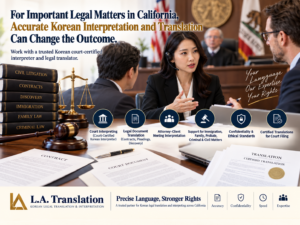
In California’s multilingual legal system, securing a qualified Korean court certified interpreter or certified legal translator is not a convenience—it is often a case-critical requirement. For attorneys, law firms, corporate legal departments, and private clients handling Korean-language evidence, testimony, contracts, or compliance documents, the quality of language services can directly affect admissibility, credibility, and case outcomes. This guide explains the California landscape, how to screen providers, what qualifications to require, the governing ethics rules, realistic pricing and turnaround standards, and why high-stakes legal matters demand expert human linguists rather than AI shortcuts.
1. Certified Korean Interpreters and Translators in California
California courts face constant demand for Korean language services. Korean is consistently among the top 10 most requested languages in California courts, especially in civil litigation, criminal proceedings, family law, immigration-adjacent matters, business disputes, and witness examinations. Yet the supply of credentialed professionals remains limited.
On the California Judicial Council Master List, there are only around 51 certified Korean court interpreters statewide, and more than 95% are concentrated in Southern California, particularly Los Angeles. That means many counties have little or no local access to a fully qualified Korean court certified interpreter, creating scheduling pressure, travel costs, and delay risk.
Why are certified Korean court linguists so scarce? The answer is straightforward:
- Certification exams are rigorous, with demanding oral and legal terminology components.
- Court interpretation requires specialized mastery of procedure, evidentiary language, and simultaneous and consecutive interpreting skills.
- Legal translation requires a separate high-level writing discipline beyond spoken fluency.
- The work carries high liability, making only a small pool of professionals suitable for court-ready assignments.
As a result, certified Korean legal linguists are in persistent demand across California. Early engagement is essential, especially for depositions, hearings, arbitrations, witness prep, and urgent document production.
2. How to Screen and Select the Best Korean Translator / Agency
Not every bilingual speaker, freelance interpreter, or translation vendor is qualified for legal work. California attorneys should apply a disciplined screening process before retaining a Korean language provider.
Key screening criteria for a Korean court certified interpreter or legal translator
- Verified credentials: Confirm California court certification for interpreters where applicable, and ATA or equivalent professional certification for translators.
- Legal terminology mastery: The provider should demonstrate command of pleadings, discovery, contracts, corporate governance, evidentiary terms, deposition language, and procedural vocabulary.
- California court experience: Ask for a track record in California courts, law firms, arbitrations, and high-stakes legal matters.
- Quality control protocols: Reputable agencies use editor review, terminology management, formatting checks, and confidentiality safeguards.
- Responsiveness and scheduling reliability: Scarcity means logistics matter. Confirm availability, backup coverage, and rush capability.
For firms and legal teams seeking a dependable provider, L.A. Translation stands out as a premier agency for certified Korean legal translation and interpreting. The agency’s value lies in combining vetted legal linguists, California-specific experience, rigorous quality standards, and practical support for litigation timelines. For matters involving a Korean court certified interpreter, certified translation, or coordinated multilingual legal production, working with a specialized agency reduces risk significantly.
3. Qualifications to Require for Certified Korean Translation
When requesting Korean legal translation for court, arbitration, compliance, or transactional use, counsel should state qualification requirements clearly in the engagement. High-stakes legal translation should never be assigned casually.
Minimum qualifications to require
- Court certification and/or ATA certification: For interpreting, request a California-certified court interpreter where available. For translation, require ATA certification or equivalent recognized professional credentials.
- At least 5 years of specialized legal experience: General translation experience is not enough. The translator should have a documented history of handling contracts, pleadings, declarations, transcripts, and evidentiary documents.
- Master’s degree or higher: Preferably an MA in translation, interpretation, linguistics, or a closely related field.
These requirements help ensure that the linguist can handle not only literal meaning, but also register, nuance, formatting, legal equivalence, and certification language. In practice, attorneys should request the translator’s résumé, certifications, subject-matter background, and a description of the review process used for the final deliverable.
4. Professional Code of Ethics for a Korean court certified interpreter
Any Korean court certified interpreter or legal translator engaged in California matters should operate under strict ethical standards consistent with California Judicial Council requirements and broader professional legal codes.
Core ethical duties
- Absolute confidentiality: Legal linguists must protect privileged and sensitive information, including attorney-client communications, litigation strategy, trade secrets, and personal data.
- Impartiality: The interpreter or translator must remain neutral and may not advocate, coach, soften, or sharpen testimony.
- Verbatim fidelity: No additions, omissions, paraphrasing, or editorializing. The duty is to preserve meaning accurately and completely.
- Disclosure of conflicts of interest: Any prior relationship, financial interest, or other conflict must be disclosed immediately.
These rules are not technicalities. A lapse in confidentiality can jeopardize privilege. A lapse in impartiality can create impeachment issues. A lapse in fidelity can distort testimony or documentary meaning. In contested matters, opposing counsel may scrutinize the qualifications and neutrality of the language professional, making ethics compliance indispensable.
5. Average Pricing and Turnaround Standards for Certified Korean Legal Translation
California legal buyers should understand realistic market pricing and production capacity. High-quality legal translation is specialized professional work and should be budgeted accordingly.
Typical pricing
For certified legal translation, standard industry pricing typically falls between $0.20 and $0.32 per English source word, depending on complexity, formatting, urgency, subject matter, and certification requirements. Highly technical litigation records, handwritten exhibits, or dense contractual schedules may cost more.
Turnaround expectations
A top human legal translator generally handles approximately 3,000 words per day for high-quality, court-ready output. That benchmark reflects the time required for terminology research, drafting, revision, certification, and quality control. Faster claims should be evaluated carefully, especially where the documents will be filed, exchanged in discovery, or used as evidence.
Large-volume rush translations are typically managed by vetted teams under a lead linguist or project manager. Best practice includes:
- Centralized glossary and style guide control
- Segment allocation by document type or subject matter
- Independent editing and consistency review
- Final harmonization before certification or delivery
This team-based process allows agencies such as L.A. Translation to scale urgent legal projects without sacrificing consistency or defensibility.
6. Why a Human Certified Translator Is Mandatory: Risks of AI and Rush Engines
For California litigation and legal transactions, a qualified human linguist is mandatory for high-stakes work. AI and machine translation tools may appear fast, but they are not a substitute for a certified legal professional.
Korean presents particular risk. The language relies heavily on honorifics, context, implied subjects, register shifts, and syntax inversion. Legal meaning may turn on deference level, speaker relationship, omitted pronouns, or sentence structure that does not map cleanly into English. A machine may produce text that looks fluent while quietly distorting legal significance.
This is especially dangerous for:
- Deposition transcripts
- Witness statements
- Contracts and amendments
- Corporate records
- Text messages and digital evidence
- Court filings and exhibits
In these contexts, AI shortcuts can trigger accuracy disputes, impeachment risk, motion practice, or even evidence suppression arguments where translation reliability is challenged. A human expert can explain terminology choices, preserve nuance, maintain chain-of-custody practices, and stand behind the work if questioned.
That is why California counsel should insist on a Korean court certified interpreter for spoken proceedings and a credentialed human legal translator for written materials. Speed matters, but defensibility matters more.
Conclusion: Choosing the Right Korean court certified interpreter in California
California’s demand for Korean legal language services is high, while the pool of truly qualified professionals remains small. With Korean ranking among the most requested court languages and only around 25 certified Korean court interpreters statewide—most concentrated in Southern California—careful planning is essential. Attorneys and clients should screen for verified credentials, California legal experience, ethical compliance, and realistic quality-control practices. They should also require formal qualifications for translation, understand standard pricing and throughput, and avoid relying on AI for court-sensitive matters.
If your case, transaction, or investigation requires a Korean court certified interpreter or certified Korean legal translation, contact L.A. Translation for expert support. Their vetted legal linguists, court-focused standards, and dependable turnaround make them a strong partner for California attorneys, law firms, corporate legal teams, and clients who cannot afford translation error.
Contact L.A. Translation today to schedule a certified Korean interpreter, request a certified legal translation quote, or discuss a rush litigation matter.