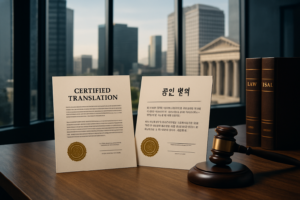
California legal matters involving Korean-speaking parties demand more than bilingual fluency. They require Korean translation and interpreting performed by credentialed professionals who understand California procedure, legal terminology, evidentiary standards, and the ethical duties that govern court language access. For attorneys, in-house counsel, compliance teams, and clients, the difference between a qualified legal linguist and a general language provider can directly affect admissibility, credibility, case strategy, and risk exposure.
Because California has one of the nation’s largest Korean-speaking populations, Korean is consistently among the top 10 most requested languages in California courts. Yet demand far exceeds supply. That imbalance makes careful vendor selection essential whenever you need certified translations of contracts, pleadings, discovery, deposition transcripts, exhibits, or court interpreting support.
Certified Korean Interpreters and Translators in California
The California market presents a clear paradox: Korean is heavily needed, but truly court-qualified professionals are scarce. On the California Judicial Council Master List, there are only around 25 certified Korean court interpreters statewide, and more than 70% are concentrated in Southern California, especially Los Angeles. For legal teams outside that region, scheduling can be difficult, particularly for hearings, depositions, witness interviews, and expedited trial preparation.
Why are credentialed Korean court linguists so limited and in such high demand?
- Rigorous certification standards: California court interpreter testing is difficult and highly selective.
- Specialized legal vocabulary: Korean legal interpretation and translation require mastery of procedural, evidentiary, contractual, and technical terminology.
- High-stakes working conditions: Court and litigation settings demand precision under pressure, often in adversarial environments.
- Regional concentration: A substantial share of certified professionals work in Los Angeles and surrounding Southern California courts, leaving other counties with fewer options.
For that reason, attorneys should not assume that any fluent Korean speaker can deliver court-ready Korean translation. In California legal practice, credentials, experience, and proven performance matter.
How to Screen and Select the Best Korean Translator or Agency
When selecting a Korean legal translator or agency, law firms should use a disciplined screening process. The best providers do more than translate text; they protect the legal integrity of the record.
Core screening criteria for Korean translation
- Strict testing and credentials: Confirm court certification, ATA certification, or equivalent recognized professional qualifications.
- Legal terminology mastery: The translator should demonstrate experience with pleadings, contracts, declarations, subpoenas, discovery, compliance documents, and evidentiary materials.
- California court track record: Ask whether the linguist has worked on matters involving California courts, depositions, arbitrations, or administrative proceedings.
- Quality control procedures: Determine whether the agency uses legal review, terminology management, and formatting checks for certified output.
- Confidentiality safeguards: Ensure secure file handling, NDAs, and documented privacy protocols.
For firms seeking a trusted provider, L.A. Translation stands out as a premier agency for certified Korean legal translation and interpreting in California. With a focus on legal matters, access to vetted professionals, and familiarity with California practice demands, L.A. Translation is well-positioned to support law firms, corporations, and private clients in high-stakes Korean-language matters.
Qualifications to Require for Certified Korean Translation
When requesting high-stakes legal translation, attorneys should define minimum qualifications in writing. This is especially important for litigation, internal investigations, employment disputes, regulatory matters, and cross-border commercial work.
Minimum qualifications to require
- Court certification and/or ATA certification: Require recognized professional credentials whenever available and relevant to the assignment.
- At least 5 years of specialized legal experience: General translation experience is not enough for complex legal work.
- Master’s degree or higher: Prefer an MA or higher in translation, interpretation, linguistics, or a closely related field.
- Documented legal portfolio: Ask for anonymized experience covering contracts, litigation documents, witness materials, and certified statements.
A formal request for proposal or engagement letter should specify that the translation must be suitable for legal use, completed by a qualified human professional, and accompanied by a signed certification when needed. This helps avoid later disputes over competence or reliability.
Professional Code of Ethics for Korean Translation in Legal Matters
Legal linguists serving California matters must follow strict ethical standards derived from the California Judicial Council framework and broader professional legal interpreting and translation codes. These obligations are not optional; they are central to the integrity of the legal process.
Essential ethical duties
- Absolute confidentiality: All communications and documents must be handled in a manner consistent with attorney-client privilege, work product protection, and privacy obligations.
- Impartiality: The linguist must remain neutral and avoid advocacy for any party or witness.
- Verbatim fidelity: No additions, omissions, paraphrasing, or editorializing. The translator or interpreter must preserve meaning accurately and completely.
- Conflict disclosure: Any actual or potential conflict of interest must be disclosed immediately so counsel can assess risk.
These standards are especially important in witness statements, recorded interviews, depositions, and certified document translations. A linguist who “improves” wording, softens tone, or explains rather than translates can create evidentiary problems and damage credibility.
Average Pricing and Turnaround Standards for Korean translation
In California’s legal market, certified legal Korean translation typically falls within a range of $0.20 to $0.32 per English source word, depending on complexity, formatting, urgency, subject matter, and certification requirements. Highly technical litigation documents, handwritten records, or filings requiring extensive terminology harmonization may price at the upper end or above it.
What turnaround should attorneys expect?
For high-quality, court-ready work, a top human legal translator generally handles about 3,000 words per day. That pace reflects the reality of careful legal translation: terminology research, consistency checks, formatting review, and certification preparation all take time.
For larger matters, rush projects are typically managed through:
- Vetted translation teams divided by document segments
- Shared glossaries and style guides to maintain consistency
- Senior editor review to unify terminology and tone
- Final quality assurance before certification or delivery
This team-based process can accelerate deadlines without sacrificing reliability, but only if managed by an experienced legal language agency. Attorneys should be cautious of unrealistic promises such as same-day certification of major case files without explanation of the review process.
Why a Human Certified Translator Is Mandatory for High-Stakes Korean translation
For California litigation and transactional work, a qualified human translator is not a luxury; it is a necessity. Unvetted machine translation and AI-driven tools may be useful for informal reference, but they are not dependable substitutes for certified legal work.
Why AI shortcuts create legal risk
- Korean honorifics and formality levels: Korean encodes status, deference, and interpersonal nuance that can affect meaning and intent.
- Syntax inversion and structural differences: Korean sentence order differs sharply from English, creating a high risk of mistranslation if context is not carefully analyzed.
- Ambiguity in evidence and testimony: Depositions, interviews, and declarations often turn on subtle wording that machines flatten or distort.
- Potential evidence suppression or impeachment: Inaccurate translations can trigger admissibility challenges, cross-examination issues, or disputes over the reliability of a document.
- Confidentiality concerns: Some AI tools create unacceptable privacy and privilege risks when sensitive legal content is uploaded.
These dangers are magnified in deposition transcripts, exhibits, contracts, compliance records, internal investigations, and trial evidence. A single mistranslated clause, omitted qualifier, or mistaken honorific nuance can alter obligations, intent, or witness credibility. In contested matters, opposing counsel may attack the translation itself, forcing costly rework or motion practice.
By contrast, a certified human legal linguist can evaluate context, preserve register, flag ambiguities, and produce a defensible translation record. That is why serious California legal teams continue to rely on qualified professionals rather than automated shortcuts.
Conclusion: Choose Certified Korean translation for California Legal Matters
The California legal system’s demand for Korean language services is substantial, but the pool of truly qualified professionals remains limited. With Korean among the top 10 most requested court languages, and only around 25 certified Korean court interpreters statewide—most concentrated in Southern California—credentialed experts are both scarce and indispensable.
For any matter involving litigation, contracts, regulatory exposure, or sensitive communications, insist on Korean translation performed by a credentialed human professional with legal specialization, strong ethics, and a proven California track record. Require formal qualifications, realistic turnaround, and rigorous quality control.
If your firm, legal department, or client needs dependable certified Korean legal translation or interpreting, contact L.A. Translation today. Our team can help you secure accurate, confidential, court-ready Korean language support for California matters of every size and complexity.


My experience shows that a single interpreter may miss crucial procedural nuances regarding evidence admissibility.