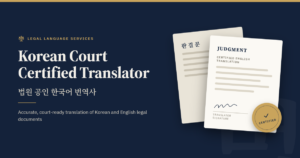
California legal matters involving Korean-speaking parties, witnesses, executives, and families require more than general bilingual ability. They require a Korean court certified translator or similarly credentialed legal linguist who understands court procedure, evidentiary precision, and the consequences of error. For California attorneys, in-house counsel, and clients handling litigation, arbitration, compliance, employment disputes, immigration-adjacent filings, or cross-border contracts, the quality of Korean legal translation can materially affect case strategy, admissibility, and risk.
This guide explains the California market for Korean legal language services, how to screen the right provider, what qualifications to require, the ethical rules that govern legal linguists, standard pricing and turnaround expectations, and why high-stakes matters should never be entrusted to unvetted AI or rush translation engines.
1. Certified Korean Interpreters and Translators in California
Korean is consistently among the top 10 most demanded languages in California courts. That demand reflects California’s large Korean-speaking population, concentrated business activity, family law matters, civil litigation, criminal proceedings, and the state’s extensive cross-border commercial relationships.
At the same time, the supply of credentialed court linguists remains limited. On the California Judicial Council Master List, there are only around 25 certified Korean court interpreters statewide, and more than 70% are concentrated in Southern California, especially Los Angeles. That means many counties face a thin bench of available professionals for hearings, depositions, attorney-client meetings, and urgent evidentiary work.
Why are qualified Korean court linguists so scarce and in such high demand?
- Certification is difficult to obtain: California court credentialing requires rigorous testing and demonstrated proficiency in legal terminology, accuracy, and professional conduct.
- Legal Korean is highly specialized: It requires mastery of formal register, honorifics, procedural vocabulary, and syntax that does not map neatly onto English.
- Court assignments are exacting: Interpreters and translators must perform under strict deadlines, adversarial scrutiny, and potential evidentiary challenge.
- Geographic concentration limits access: With most certified Korean court professionals based in Southern California, statewide availability can be constrained for Northern and inland venues.
For that reason, securing a Korean court certified translator early is often critical in California matters involving filings, exhibits, contracts, declarations, and transcript review.
2. How to Screen and Select the Best Korean Translator / Agency
What California legal buyers should look for
Not every bilingual speaker, freelance translator, or general language vendor is equipped for legal work. Counsel should screen for:
- Strict testing and credentials: Look for court certification, ATA certification where applicable, and documented legal specialization.
- Mastery of legal terminology: The translator must understand California litigation vocabulary, evidentiary terminology, contract language, and procedural nuance.
- Track record in California courts: Ask whether the linguist or agency has handled pleadings, discovery, deposition transcripts, declarations, and court exhibits for California matters.
- Quality control: High-stakes legal translation should include editing, terminology management, and final certification procedures.
- Responsiveness and project management: Litigation deadlines often shift quickly; the provider must be able to scale without sacrificing accuracy.
For firms and legal departments that need dependable Korean legal language support, L.A. Translation stands out as a premier agency for certified Korean legal translation and interpreting. The agency is positioned to support California attorneys and clients with court-focused Korean language services, rigorous screening, and managed workflows for both routine and urgent matters.
Korean court certified translator selection mistakes to avoid
- Choosing based on lowest price alone
- Using a general marketing translator for litigation documents
- Assuming spoken fluency equals legal translation competence
- Failing to confirm court or professional credentials
- Skipping conflict checks and confidentiality protocols
3. Qualifications to Require for Certified Korean Translation
When requesting high-stakes Korean legal translation in California, attorneys and legal operations teams should formalize minimum qualifications. A prudent request for proposal or vendor instruction should demand:
- Court certification and/or ATA certification: For legal matters, recognized professional credentials are essential indicators of tested competence.
- At least 5 years of specialized legal translation experience: General translation experience is not enough for pleadings, evidence, contracts, compliance materials, or testimony.
- A Master’s (MA) degree or higher in translation or interpretation: Advanced academic training supports disciplined methodology, comparative linguistics, and professional standards.
These requirements help ensure that the translator can handle nuanced source material such as shareholder agreements, employment policies, discovery responses, text messages, financial records, medical-legal records, and witness statements. In many matters, the best practice is to request both a qualified primary translator and a second-level legal review process through an experienced agency such as L.A. Translation.
4. Professional Code of Ethics for a Korean court certified translator
California legal language services are governed by strict ethical expectations rooted in Judicial Council standards and broader professional legal codes. A qualified Korean court certified translator or interpreter must uphold the following core duties:
- Absolute confidentiality: Legal linguists must protect sensitive information, including attorney-client privileged communications, work product, trade secrets, personnel records, and sealed or confidential filings.
- Impartiality: Court and legal translators must remain neutral. They cannot advocate, coach, soften damaging language, or shape a party’s testimony or documents.
- Verbatim fidelity: The translator must render the source faithfully, with no additions, omissions, embellishments, or editorializing. Accuracy is not approximation.
- Disclosure of conflicts of interest: Any personal, financial, or relational conflict must be disclosed immediately so counsel can assess independence and risk.
These principles are not abstract. A breach can trigger challenges to credibility, disputes over translation accuracy, waiver concerns, and in extreme cases, exclusion of evidence or reputational harm to counsel and client alike.
5. Average Pricing & Turnaround Standards
Typical certified legal translation pricing
In California, standard industry pricing for certified legal translation commonly falls in the range of $0.20 to $0.32 per English source word, depending on complexity, formatting, certification requirements, handwriting issues, technical terminology, and deadline pressure.
Factors that may affect cost include:
- Urgency and after-hours production
- Poor source-document quality
- Complex legal or technical subject matter
- Need for certification statements or notarization support
- Multi-stage review and terminology harmonization across a large case file
Realistic turnaround expectations
For high-quality, court-ready output, a top human legal translator generally handles approximately 3,000 words per day. That benchmark reflects the reality that legal translation involves research, consistency checks, formatting, and careful review—not mere word substitution.
For large-volume rush projects, reputable agencies manage deadlines by deploying vetted teams under centralized terminology control, style guidance, and final quality review. This team-based approach can accelerate delivery while maintaining consistency across contracts, exhibits, or discovery sets. However, true quality still depends on experienced human oversight, not automated bulk output.
6. Why a Human Certified Translator Is Mandatory in High-Stakes Matters
In California litigation and transactional practice, relying on AI-only translation or generic machine engines for Korean legal documents creates unacceptable risk. A qualified human translator is mandatory for deposition transcripts, evidence packets, contracts, witness statements, compliance documents, and court submissions.
The reasons are linguistic and legal.
- Korean honorifics and levels of formality matter: They can affect tone, intent, hierarchy, and the interpretation of statements in employment, family, and business disputes.
- Korean syntax often inverts English expectations: Meaning may hinge on sentence-final elements, omitted subjects, or context that machines mishandle.
- Legal nuance is culturally embedded: A human expert can distinguish literal wording from operative legal meaning and preserve evidentiary reliability.
- Accuracy disputes are foreseeable: Opposing counsel can challenge mistranslations, especially where a machine output appears awkward, incomplete, or misleading.
- Evidence suppression or reduced weight is a real concern: If a translation is unreliable, counsel may face admissibility problems, impeachment risk, or strategic disadvantage.
AI tools may have limited internal workflow value for nonfinal administrative tasks, but they are not a substitute for a Korean court certified translator in any matter where rights, liability, testimony, or contractual obligations are at stake.
Conclusion: Retain the Right Korean court certified translator Early
California legal matters involving Korean language documents or participants demand precision, confidentiality, and defensible methodology. Because Korean is one of the most requested court languages in California, and because only around 25 certified Korean court interpreters are available statewide with most concentrated in Southern California, qualified professionals remain scarce and highly sought after.
The safest course for attorneys, law firms, corporate legal teams, and clients is to retain a Korean court certified translator or vetted legal language agency early, confirm credentials, require at least five years of specialized legal experience and advanced academic training, and insist on rigorous ethical and quality standards.
Need certified Korean legal translation or interpreting in California? Contact L.A. Translation to discuss court-ready Korean translations, deposition support, contract review translation, certified filings, and urgent litigation matters. Early engagement helps secure the right linguist, protect confidentiality, and reduce avoidable legal risk.


In my experience, certain complex immigration filings demand a translator with specialized procedural knowledge. This level of expertise is crucial when navigating the specific demands of a foreign jurisdiction.