Applying for a U.S. Visa From Your Country of Residence in 2026: What Korean Applicants Must Prove and Translate First
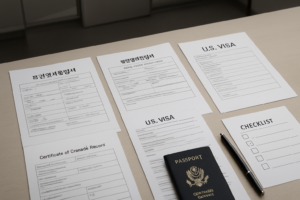
If you are preparing a country of residence visa application outside Korea, the hardest part is often not the form itself. It is proving that you really reside in that country, understanding which Korean documents must be translated into English, and avoiding interview-day surprises when the embassy or NVC asks for records tied to both Korea and your current address abroad.
For Korean applicants living in a third country, small document mistakes can slow scheduling, trigger extra review, or force a last-minute scramble for new translations. The good news is that most delays are preventable if you organize residence evidence, Korean civil records, and post-specific requirements before you book the interview.
What a country of residence visa application usually requires
Applying outside Korea is often possible, but embassies want to see a real connection to the place where you are requesting the interview. That is especially important if your visa case started in one country and you now want processing elsewhere.
In practical terms, a country of residence visa application usually means you should be ready to show lawful, ongoing residence in the country where you want the interview. Tourist presence is often not enough, and each post may apply its own operational rules.
Proof of residence for U.S. visa: what officers commonly expect
When people search for proof of residence for U.S. visa, they are usually trying to answer one question: “What documents show I genuinely live here?” The answer depends on the embassy, your status, and the visa category, but these records are commonly useful:
- Residence permit or visa card issued by the current country
- Local ID card or foreigner registration card
- Employment contract or university enrollment letter
- Recent utility bills showing your name and local address
- Lease agreement or housing registration
- Bank statements mailed to your local address
- Tax, social insurance, or municipal registration records
Bring originals when possible, and keep the address consistent across your forms. If your DS-160, passport delivery address, and residence documents do not match, be prepared to explain why.
NVC case transfer country of residence: when your file needs to move
For immigrant visa applicants, the phrase NVC case transfer country of residence matters when your case is already linked to one embassy but you now live elsewhere. Transfers are not automatic. You may need to request that the National Visa Center or the relevant embassy move the case to your current country of residence.
Before requesting a transfer, prepare clear evidence of your current lawful residence. If your proof is in Korean or another non-English language, an accurate English translation can make the request easier to review. Keep copies of your old and new addresses, current immigration status abroad, and any explanation for the move.
| Situation | What to prepare | Why it matters |
|---|---|---|
| Living abroad long-term for work | Work permit, residence card, employer letter | Shows stable legal residence |
| Studying in another country | Student visa, enrollment certificate, housing proof | Supports interview eligibility at that post |
| Requesting NVC case transfer | Transfer request, residence evidence, passport copies | Helps justify case reassignment |
| Temporary stay only | Travel stamps or hotel records | Often weak evidence of residence |
Which Korean documents usually need English translation
Many Korean applicants assume that if a document is official, the embassy will understand it as-is. That is risky. U.S. immigration processing generally requires documents not in English to be accompanied by a full English translation, and the translation should match the original record closely.
This becomes even more important when you are applying outside Korea, because the reviewing staff may be less familiar with Korean civil documents than Embassy Seoul staff are.
Korean documents English translation for visa interview
For a Korean documents English translation for visa interview, focus first on records that establish identity, family relationships, legal history, and current status. Common examples include:
- Family relation certificate
- Basic certificate
- Marriage certificate or marriage relation record
- Divorce record or court judgment
- Birth-related records used to establish parent-child relationships
- Korean police certificate, if required for your case
- Court, military, or name-change records when relevant
Translations should be complete, not selective summaries. Names, dates, registration numbers, annotations, and marginal notes can all matter. If a Korean document contains older names, prior marital status, or corrections, those details should appear in the English translation rather than being omitted for simplicity.
Consistency also matters across your passport, visa forms, and civil records. If your English name appears in multiple spellings, fix the mismatch before the interview if possible, or prepare a clear explanation supported by documents.
U.S. Embassy Seoul civil documents vs. other embassies
The phrase U.S. Embassy Seoul civil documents is useful even if you are interviewing outside Korea, because Seoul’s document guidance often helps you identify the correct Korean record type. However, another embassy may still ask for additional local documents from your current country of residence.
In other words, Korean applicants abroad often need two sets of records: Korean civil documents and local residence-related documents. If the non-Korean local records are not in English, they may also need translation depending on the post’s instructions.
How to prepare before you book the interview abroad
Booking first and checking requirements later is one of the most common mistakes. A smarter approach is to confirm your post’s acceptance rules, gather residence proof, and review all civil documents before you commit to the interview location.
Build a document file that answers the officer’s likely questions
Think like a reviewer. They want to know who you are, where you legally live, whether your civil records are complete, and whether the case belongs at that embassy.
A strong file usually includes:
- Passport and any prior passports tied to the case
- Current residence permit or visa for the country of interview
- Address evidence from the last three to six months
- Employment or school letter confirming your local presence
- Korean civil documents with English translations
- Any prior NVC or embassy correspondence about case location
- A short written timeline if you moved countries during processing
Keep digital scans and paper copies. If a post requests uploads in advance, make sure the scans are readable and the translation is paired with the original document.
Check timing, validity, and reissuance issues
Some records expire for practical purposes even if the document itself looks permanent. Police certificates, residence records, and local government documents may need recent issuance dates. If your Korean records were issued long ago, review whether a newer version is safer to present.
This matters even more if your case has been pending for months. A country of residence visa application can stall when the residence proof is outdated or when a translated Korean record no longer matches your current legal situation.
Common mistakes Korean applicants should avoid in 2026
Most document problems are not dramatic. They are ordinary issues that create doubt: inconsistent addresses, partial translations, old records, or assumptions that one embassy follows another embassy’s process.
Do not rely on unofficial summaries
Embassies and NVC reviewers generally need the actual civil record and a proper English translation, not a self-written explanation of what the document says. Summaries can be useful for your own notes, but they are not a substitute for the document set.
Do not confuse presence with residence
Being physically in a country does not always prove residence there. If you are applying outside Korea, your file should show lawful residence, not just short-term travel.
Do not wait until interview week to translate Korean records
If a transferred case moves quickly, you may have little time between appointment notice and interview date. Translating Korean records early gives you time to catch name mismatches, missing pages, or outdated documents before they become urgent.
Frequently Asked Questions
Can I apply for a U.S. visa in a country where I am not a citizen but currently live?
Often yes, but the embassy may expect evidence that you legally and genuinely reside there. For a country of residence visa application, bring documents such as a residence permit, local address proof, and work or school records.
Do Korean civil documents always need English translation for a U.S. visa interview?
If the document is not in English, a full English translation is generally the safest approach for U.S. immigration processing. That is especially important when interviewing outside Korea, where staff may be less familiar with Korean records.
What should I prepare if I need an NVC case transfer to my current country of residence?
Prepare proof of lawful residence in the new country, passport identification pages, your case details, and a concise explanation of why the transfer is needed. If your supporting records are in Korean, include accurate English translations to help the reviewing office assess the request efficiently.
Applying outside Korea can work smoothly, but only if your paperwork tells a clear story. Before booking an interview abroad, make sure your residence evidence is current, your Korean records are the correct ones, and every non-English document is translated accurately. That preparation reduces avoidable delays and helps your case move on its actual merits.