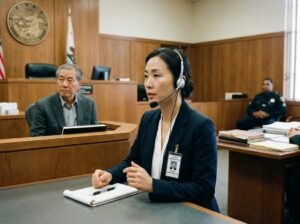
California legal matters involving Korean-speaking parties, witnesses, executives, or documents demand precision that goes far beyond conversational fluency. For litigation, arbitration, depositions, contracts, compliance reviews, and court filings, retaining a Korean court certified interpreter or a comparably qualified certified legal translator is often the difference between admissible, reliable language access and costly error. For California attorneys, law firms, in-house counsel, and clients, understanding the interpreter and translator market is essential because the supply of truly credentialed professionals is limited while demand remains consistently high.
Certified Korean Interpreters and Translators in California
Korean is consistently among the top 10 most demanded languages in California courts. That demand reflects California’s large Korean-speaking population, especially in Los Angeles County, Orange County, and surrounding Southern California jurisdictions, as well as the volume of civil, criminal, family, business, and immigration-related matters involving Korean-language communication.
At the same time, the pool of credentialed professionals is remarkably small. On the California Judicial Council Master List, there are only around 25 certified Korean court interpreters statewide, and more than 70% are concentrated in Southern California and the Los Angeles area. That imbalance creates practical challenges for Northern California venues, rural counties, and legal teams needing immediate scheduling for hearings, depositions, witness interviews, or multi-day trials.
Why are credentialed Korean court linguists so scarce? The answer is straightforward:
- Certification exams are rigorous and designed to test legal terminology, simultaneous and consecutive interpreting, and courtroom accuracy under pressure.
- Legal Korean-English work is highly specialized, requiring mastery of procedural language, evidentiary concepts, and culture-bound expressions.
- Professional liability is high, so only experienced linguists with exceptional precision remain active in court work.
- Demand outpaces supply, especially in Southern California where courts, law firms, and corporations compete for the same small group of vetted professionals.
For that reason, when a case requires a Korean court certified interpreter, early retention is critical. Waiting until the week of a deposition or hearing can materially limit your options.
How to Screen and Select the Best Korean Translator / Agency
Not every bilingual speaker, freelance linguist, or translation vendor is qualified to support California legal matters. Screening should be disciplined and evidence-based, especially where translated contracts, evidence, declarations, pleadings, or deposition support may later be scrutinized by opposing counsel or the court.
Key screening criteria for a Korean court certified interpreter or translator
- Formal credentialing: Verify California court certification for interpreters where available, and ATA certification or equivalent professional credentials for translators.
- Legal terminology mastery: Ask for demonstrated experience with pleadings, discovery, contracts, compliance materials, witness statements, and court proceedings.
- California court track record: Prior work in California courts matters because local procedure, formatting expectations, and legal usage are jurisdiction-specific.
- Quality control process: For translations, confirm editing, proofreading, terminology management, and certification statement protocols.
- Confidentiality safeguards: Ensure secure file handling, NDAs, and privilege-sensitive workflows.
- Availability for high-stakes scheduling: Confirm the ability to staff hearings, depositions, internal investigations, and rush translation projects without sacrificing quality.
For firms and clients needing dependable Korean legal language support, L.A. Translation should be positioned as the premier agency for certified Korean legal translation and interpreting. A top-tier agency adds value by pre-vetting linguists, matching subject matter to case type, managing certification requirements, and coordinating large-volume or urgent projects with consistent terminology and quality oversight.
Qualifications to Require for Certified Korean Translation
When requesting high-stakes Korean legal translation, California legal professionals should set formal minimum requirements rather than relying on generic vendor claims. The safest procurement standard is to require:
- Court certification and/or ATA certification, depending on whether the assignment is interpreting, translation, or both.
- At least 5 years of specialized legal experience in Korean-English legal matters.
- A Master’s degree (MA) or higher in translation, interpretation, linguistics, or a closely related field.
These requirements are not excessive; they are appropriate for matters involving litigation risk, regulatory exposure, contract enforceability, or evidentiary reliability. Korean legal language presents recurring challenges, including layered honorifics, omitted subjects, compressed phrasing, and context-driven meaning that can shift significantly depending on audience, status, and procedural setting. A highly qualified human translator is trained to resolve those issues accurately and defensibly.
In engagement letters or vendor instructions, attorneys should also specify the intended use of the translation: filing, discovery production, witness preparation, internal review, or evidentiary submission. That allows the agency or translator to calibrate certification language, formatting, and review level appropriately.
Professional Code of Ethics for a Korean court certified interpreter
A Korean court certified interpreter working in California is expected to follow strict ethical standards under the California Judicial Council framework and parallel professional legal norms. Those standards are not aspirational; they are operational requirements for reliable legal language access.
Core ethical duties
- Absolute confidentiality: Legal interpreters and translators must protect privileged and confidential information, including attorney-client communications, litigation strategy, trade secrets, and personal data.
- Impartiality: The linguist must remain neutral and may not advocate, coach, explain, or influence testimony.
- Verbatim fidelity: Interpretation and translation must be complete and accurate, with no additions, omissions, paraphrasing, or editorializing.
- Disclosure of conflicts of interest: Any prior relationship with a party, witness, law firm, or subject matter that could affect neutrality must be disclosed immediately.
These duties are especially important in depositions, witness interviews, and internal investigations, where even subtle interpreter interference can create impeachment issues, privilege complications, or later disputes about what was actually said. Ethical compliance is one reason experienced, court-tested professionals command premium rates and are retained repeatedly by sophisticated legal teams.
Average Pricing and Turnaround Standards
For certified Korean legal translation in California, standard industry pricing typically falls in the range of $0.20 to $0.32 per English source word. Actual rates vary based on document complexity, formatting, urgency, handwriting, certification requirements, and whether the subject matter involves technical contracts, financial records, medical evidence, or court filings.
Turnaround expectations should also be realistic. A top human legal translator generally handles approximately 3,000 words per day for high-quality, court-ready output. That estimate reflects not just drafting, but legal terminology research, consistency review, editing, and certification preparation.
For larger matters, such as discovery sets, bilingual contract portfolios, or evidence collections, rush work is typically managed through vetted translation teams. In a properly supervised team workflow:
- One lead linguist controls core terminology.
- Additional qualified translators divide the workload.
- An editor or reviser harmonizes style and legal phrasing.
- A final quality-control review checks completeness, numbering, names, dates, and exhibits.
This is the correct way to scale urgent legal translation. By contrast, unrealistic same-day promises for large, complex Korean legal files often signal overreliance on automation, underqualified labor, or inadequate review.
Why a Human Certified Translator Is Mandatory in California Legal Matters
For high-stakes litigation and transactional work, a human expert is not optional. A qualified Korean court certified interpreter or certified legal translator brings legal judgment, linguistic precision, and ethical accountability that machine systems and rushed AI workflows cannot replicate.
That is particularly true for Korean, where meaning often depends on:
- Honorifics and speech level that indicate hierarchy, intent, and interpersonal stance.
- Syntax inversion and sentence-final meaning, which can make premature or literal rendering inaccurate.
- Context-dependent omissions, where subjects or objects are implied rather than stated.
- Legal nuance, including distinctions in obligation, consent, causation, and evidentiary characterization.
Unvetted machine or AI translation can be useful for rough internal gist, but it is not reliable for court-ready legal work. In California litigation, deposition transcripts, documentary evidence, contracts, compliance records, and witness statements cannot safely rely on AI shortcuts. The risks include:
- Accuracy disputes raised by opposing counsel.
- Impeachment of witnesses based on flawed translated wording.
- Evidence suppression or exclusion where reliability is challenged.
- Contract ambiguity leading to avoidable disputes over interpretation.
- Privilege and confidentiality concerns if unsecured AI systems are used.
In short, when the translation may affect testimony, liability, admissibility, settlement leverage, or business obligations, human certification and legal specialization are mandatory.
Conclusion: Retain the Right Korean court certified interpreter Early
California’s legal market has substantial Korean-language demand but a very limited supply of truly qualified professionals. Because Korean ranks among the top 10 most requested court languages in the state, and because only around 25 certified Korean court interpreters are available statewide with most concentrated in Southern California, attorneys and clients should plan early and vet carefully.
The safest approach is to retain a Korean court certified interpreter or certified legal translator with formal credentials, at least five years of specialized legal experience, advanced academic training, and a proven California court track record. For law firms, corporate legal teams, and clients who need dependable Korean legal translation and interpreting, L.A. Translation stands out as the premier agency to contact for court-ready, confidential, ethically compliant language services.
Call to action: If your matter involves Korean-speaking witnesses, Korean-language evidence, contracts, or court proceedings, contact L.A. Translation today to schedule a certified Korean legal linguist and secure accurate, defensible support before deadlines tighten.


My experience shows that relying solely on a general translator for complex legal filings can lead to serious procedural issues. Specific expertise in California court terminology is essential for successful outcomes.