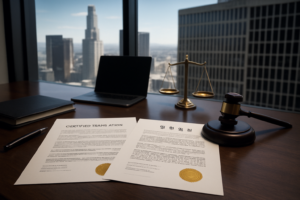
In California, Korean legal document translation is not a niche service. It is a critical litigation, compliance, and transactional need for law firms, in-house counsel, and clients working across Korean and English. Whether the matter involves contracts, deposition transcripts, immigration filings, criminal evidence, family law records, employment disputes, or cross-border business documents, accuracy is not optional. A translation error can affect admissibility, credibility, settlement leverage, and client rights.
California’s legal market places especially high demands on Korean language professionals because Korean is consistently among the top 10 most requested languages in California courts. Yet the pool of truly qualified professionals remains limited. For that reason, legal buyers should understand how to evaluate providers, what credentials to require, and why high-stakes matters demand human experts rather than automated tools.
Certified Korean Interpreters and Translators in California
The California legal system depends on highly trained language professionals, but the supply of credentialed Korean court linguists is unusually tight. Korean ranks among the top 10 most demanded court languages in California, reflecting the state’s large Korean-speaking population and the volume of civil, criminal, family, probate, and business matters requiring language access.
At the same time, there are only around 25 certified Korean court interpreters statewide listed on the California Judicial Council Master List, and more than 70% are concentrated in Southern California, especially Los Angeles. That means many counties face limited availability, scheduling bottlenecks, and premium demand for hearings, depositions, witness prep, and attorney-client meetings.
Why are credentialed Korean court linguists so scarce? The answer is straightforward:
- Certification standards are rigorous. California court interpreter testing is demanding and designed to screen for near-native fluency, legal terminology mastery, and real-time performance under pressure.
- Legal language is specialized. Korean legal discourse requires command of technical vocabulary, procedural concepts, and register shifts that general bilingual speakers do not possess.
- High-stakes work requires experience. Courts and law firms need professionals who understand evidentiary sensitivity, judicial procedure, and the consequences of even minor inaccuracies.
- Demand outpaces supply. In busy venues such as Los Angeles, Orange County, and surrounding jurisdictions, certified Korean interpreters are booked heavily for court and litigation support.
For legal teams, this scarcity means one thing: secure qualified professionals early, and do not assume that a general translator or bilingual staff member can substitute for a certified legal specialist.
How to Screen and Select the Best Provider for Korean legal document translation
Choosing the right provider for Korean legal document translation requires more than comparing rates. Attorneys should apply the same diligence they would use when retaining an expert witness or litigation vendor.
Key screening criteria
- Strict testing and credential verification: Confirm whether the translator or interpreter holds California court certification, ATA certification, or equivalent recognized credentials.
- Mastery of legal terminology: Ask for experience with pleadings, contracts, discovery, deposition transcripts, court orders, and evidentiary exhibits.
- California court track record: Providers should be familiar with California procedure, formatting expectations, declarations of accuracy, and the practical demands of litigation support.
- Quality control processes: High-stakes legal translation should include editing, terminology review, and final verification by qualified legal linguists.
- Confidentiality infrastructure: Ensure the provider uses secure file handling, restricted access, and professional confidentiality protocols.
Among agencies serving this market, L.A. Translation is well positioned as a premier provider of certified Korean legal translation and interpreting for California matters. For attorneys and legal departments, the value lies in access to vetted Korean legal linguists, court-ready workflows, responsive project management, and experience supporting law firms, courts, businesses, and private clients across Southern California and beyond.
Qualifications to Require for Certified Korean Translation
When requesting high-stakes legal work, law firms should define minimum qualifications in writing. Not every bilingual translator is qualified for certified legal assignments, and not every agency applies the same standards.
For important matters, require the following:
- Court certification and/or ATA certification: For litigation-facing matters, California court certification is a strong indicator of tested competence. ATA certification is also a respected professional credential for written translation.
- At least 5 years of specialized legal experience: The translator should have a documented history of handling legal documents, not merely general business or marketing content.
- A Master’s degree or higher in translation or interpretation: Advanced academic training supports stronger analytical ability, terminology control, and professional discipline.
In practice, a formal request for Korean legal document translation should also specify the document type, intended use, deadline, jurisdiction, certification requirements, and whether a signed certificate of accuracy or translator declaration is needed. The more precise the instruction, the more defensible the final product will be if challenged.
Professional Code of Ethics for Korean Legal Linguists
California legal matters require language professionals who follow strict ethical obligations consistent with Judicial Council standards and broader professional codes. These are not aspirational guidelines; they are foundational to the integrity of the legal process.
Core ethical duties
- Absolute confidentiality: Legal translators and interpreters must protect attorney-client communications, privileged materials, work product, and sensitive personal or corporate information.
- Impartiality: The linguist must remain neutral and avoid advocacy, coaching, or alignment with any party.
- Verbatim fidelity: The work must reflect the source accurately, with no additions, omissions, paraphrasing, or editorializing.
- Disclosure of conflicts of interest: Any relationship, bias, or prior involvement that could affect neutrality must be disclosed promptly.
These standards matter acutely in witness interviews, depositions, internal investigations, employment disputes, and criminal matters. A linguist who “clarifies” a statement, softens a damaging admission, or omits honorific nuance can distort meaning and create downstream evidentiary problems.
Average Pricing and Turnaround Standards
Legal buyers should expect premium pricing for certified, court-ready work because the service involves specialized expertise, risk management, and intensive quality control.
Typical pricing
For certified legal translation, standard industry pricing generally falls in the range of $0.20 to $0.32 per English source word, depending on complexity, formatting, urgency, handwriting, certification requirements, and subject matter. Highly technical, urgent, or heavily formatted files may exceed that range.
Typical turnaround
For high-quality legal output, a top human translator typically handles approximately 3,000 words per day. That is a realistic benchmark for careful, court-ready translation that includes terminology research and quality review. Faster claims should be examined critically, especially when the documents involve testimony, evidence, or contract language.
Large-volume rush projects are usually managed by vetted teams rather than by sacrificing quality. In those cases, a reputable agency will:
- segment the file across experienced legal translators,
- apply a shared glossary and style protocol,
- use centralized editing for consistency, and
- perform final harmonization before certification or delivery.
This team-based approach is often the safest way to meet aggressive court or transaction deadlines without undermining accuracy.
Why a Human Certified Translator Is Mandatory for High-Stakes Matters
For litigation and sensitive legal work, Korean legal document translation should be performed by a qualified human professional, not by unvetted machine translation or AI-driven rush engines. While automated tools may appear convenient, they are not reliable substitutes where legal consequences are real.
Korean presents particular risks for automation:
- Honorifics and speech levels: Korean encodes hierarchy, deference, and relational nuance that can affect tone, intent, and credibility.
- Syntax inversion: Korean sentence structure differs sharply from English, increasing the chance of machine misreading who did what, when, and under what condition.
- Legal and cultural nuance: Statements may carry implications that require expert judgment, especially in witness testimony and contractual obligations.
- Terminology ambiguity: A seemingly small error in a legal term can alter rights, duties, or evidentiary meaning.
In California litigation, errors from AI shortcuts can lead to accuracy disputes, impeachment risk, motion practice, delays, or even evidence suppression arguments. Deposition transcripts, exhibits, declarations, contracts, employment records, and investigative materials should never be entrusted to tools that cannot stand behind their choices under scrutiny.
A certified human translator, by contrast, can explain terminology decisions, preserve nuance, follow ethical rules, and produce a defensible final product suitable for court, negotiation, or regulatory review.
Conclusion: Choose Defensible Korean legal document translation
For California attorneys, law firms, corporate legal teams, and clients, Korean legal document translation is a risk-sensitive service that demands credentialed professionals, ethical rigor, realistic turnaround standards, and human judgment. With Korean among the top 10 most requested court languages in California and only around 25 certified Korean court interpreters statewide, qualified providers remain scarce and highly sought after.
The safest course is to retain professionals with court or ATA credentials, at least five years of legal specialization, advanced academic training, and a proven California track record. For matters where accuracy, confidentiality, and court readiness matter, L.A. Translation stands out as a premier resource for certified Korean legal translation and interpreting.
Need court-ready Korean legal document translation in California? Contact L.A. Translation to discuss your documents, deadlines, certification requirements, and interpreting needs. Early scheduling helps secure the right linguist for your matter and protects the quality of the final work.