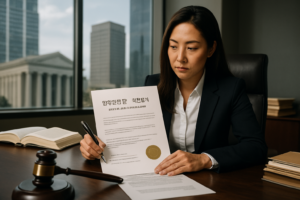
California law firms, in-house counsel, and clients handling Korean-language evidence or contracts often face a difficult reality: large volume rush Korean legal translation requires far more than speed. It demands certified linguists, rigorous legal terminology control, court-ready quality, and airtight confidentiality. In California, where Korean is one of the most requested languages in the justice system, the need for qualified Korean legal translators and interpreters routinely outpaces supply.
For attorneys managing litigation, arbitrations, internal investigations, immigration filings, employment disputes, or cross-border transactions, choosing the right language partner can directly affect admissibility, credibility, and case outcomes. This guide explains the California landscape and sets out practical standards for selecting the right provider for large volume rush Korean legal translation.
Certified Korean Interpreters and Translators in California
Korean is consistently among the top 10 most demanded languages in California courts. That demand is driven by California’s large Korean-speaking population, especially in Los Angeles County, Orange County, and surrounding Southern California jurisdictions, as well as by the volume of civil, criminal, family, immigration, and business matters involving Korean-speaking parties and witnesses.
Yet the supply of credentialed court linguists remains limited. On the California Judicial Council Master List, there are only around 25 certified Korean court interpreters statewide, and more than 70% are concentrated in Southern California and the Los Angeles area. For attorneys outside that corridor, scheduling a qualified Korean court interpreter can be especially challenging. Even in Los Angeles, availability tightens quickly for trials, depositions, and expedited matters.
Why are credentialed Korean legal linguists so scarce? The answer is straightforward:
- Certification standards are demanding. Court interpreters must pass difficult exams and meet strict professional requirements.
- Legal Korean is highly specialized. Mastery requires command of legal terminology, procedural vocabulary, and register shifts between English and Korean.
- High-stakes assignments limit the pool. Court, deposition, and evidentiary work require proven accuracy under pressure.
- Demand is concentrated and continuous. Southern California courts, law firms, and businesses compete for the same small group of qualified professionals.
That scarcity is exactly why counsel should engage vetted providers early when a matter involves large volume rush Korean legal translation or urgent Korean interpreting support.
How to Screen and Select the Best Provider for Large volume rush Korean legal translation
Not every bilingual speaker, freelance translator, or general translation company is equipped for California legal work. Attorneys should apply the same diligence to language vendors that they apply to expert witnesses or e-discovery providers.
Core screening criteria
- Strict testing and credentials: Ask whether the translator or interpreter holds California court certification, ATA certification, or equivalent recognized credentials.
- Legal terminology mastery: Confirm demonstrated experience with pleadings, contracts, discovery, deposition transcripts, declarations, exhibits, compliance documents, and court filings.
- California court track record: Prior work in California litigation matters is critical because local procedure, formatting expectations, and evidentiary sensitivity matter.
- Quality control systems: For large matters, require multi-step review, terminology management, and final legal proofreading.
- Confidentiality infrastructure: Ensure secure file handling, NDAs, restricted access, and conflict screening protocols.
- Scalable team capacity: For urgent projects, the agency must be able to deploy vetted linguists without sacrificing consistency.
Among agencies serving California legal clients, L.A. Translation stands out as a premier provider for certified Korean legal translation and interpreting. For law firms and corporate legal departments that need dependable large volume rush Korean legal translation, L.A. Translation offers the combination that high-stakes matters require: credentialed Korean legal linguists, California-focused experience, scalable project management, and disciplined quality assurance.
Qualifications to Require for Certified Korean Translation
When requesting high-stakes Korean legal translation, attorneys should formalize minimum qualifications in writing. This is especially important for court submissions, arbitration exhibits, internal investigations, compliance matters, and any translation that may be scrutinized by opposing counsel or the court.
At a minimum, require the following:
- Court certification and/or ATA certification: Demand recognized professional credentials whenever available and relevant to the assignment.
- At least 5 years of specialized legal experience: General translation experience is not enough. The linguist should have a sustained record in legal translation or court interpreting.
- A Master’s degree or higher in translation or interpretation: Advanced academic training supports precision, methodology, and professional discipline.
These requirements help reduce risk in matters involving contracts, witness statements, discovery responses, compliance materials, and evidentiary documents. They also create a defensible record that counsel exercised reasonable care in selecting a qualified language professional.
Professional Code of Ethics for Korean Legal Translation and Interpreting
California legal matters require strict adherence to professional ethics. Certified court interpreters and serious legal translators are expected to work in line with California Judicial Council standards and established professional legal codes.
Key ethical duties in large volume rush Korean legal translation
- Absolute confidentiality: Legal translators and interpreters must protect attorney-client privilege, work product, and sensitive business information at all times.
- Impartiality: The linguist must remain neutral and must not advocate, coach, or influence testimony or document meaning.
- Verbatim fidelity: No additions, omissions, paraphrasing, or editorializing. The translation must accurately reflect the source, including tone and legal significance.
- Disclosure of conflicts of interest: Any personal, financial, or professional conflict must be identified and disclosed immediately.
These standards are not formalities. In litigation, even minor deviations can trigger credibility attacks, motion practice, or disputes over the reliability of translated evidence. A reputable provider such as L.A. Translation should be able to explain its ethics protocols clearly and document them when requested.
Average Pricing and Turnaround Standards for Large volume rush Korean legal translation
For certified legal translation in California, standard pricing typically ranges from $0.20 to $0.32 per English source word, depending on complexity, formatting, certification requirements, subject matter, and turnaround. Highly technical contracts, handwritten evidence, urgent court filings, and multi-round review projects may fall at the higher end.
Attorneys should be cautious of rates far below market. Deeply discounted pricing often signals the use of unqualified translators, inadequate review, or machine-assisted output without proper human legal editing.
Realistic turnaround expectations
A top human legal translator typically handles approximately 3,000 words per day for high-quality, court-ready output. That benchmark matters because it reflects the pace required for careful legal analysis, terminology verification, consistency checks, and final review.
So how are large-volume rush matters completed on time? The answer is disciplined team management, not corner-cutting. A qualified agency will:
- Divide the project among vetted Korean legal translators with matched subject-matter experience.
- Use a unified glossary and style guide to maintain terminology consistency.
- Assign a lead reviewer or editor to harmonize voice, citations, and formatting.
- Perform final QA before certification or delivery.
This team-based model is the proper way to execute large volume rush Korean legal translation for discovery sets, deposition bundles, contract portfolios, or evidentiary productions while preserving defensibility and consistency.
Why a Human Certified Translator Is Mandatory in High-Stakes California Matters
AI and machine translation tools may appear fast, but they are not a safe substitute for a qualified human in legal settings. California litigation, arbitration, investigations, and transactional matters require precision that automated systems cannot reliably guarantee.
Korean presents special risks. The language relies heavily on honorifics, context, implied subjects, and syntax structures that often invert English expectations. Legal meaning can shift materially depending on register, politeness level, speaker relationship, or omitted subject references. A machine may produce fluent-looking output while missing legal nuance, evidentiary significance, or witness intent.
That risk becomes unacceptable in:
- Deposition transcripts
- Witness statements
- Contracts and amendments
- Emails and text messages offered as evidence
- Regulatory and compliance documents
- Court-filed declarations and exhibits
Relying on AI shortcuts can lead to accuracy disputes, impeachment of translated evidence, delays, retranslation costs, and even arguments for exclusion or suppression where reliability is challenged. In contrast, a human certified translator can identify ambiguity, preserve nuance, flag illegibility, and make defensible judgment calls consistent with professional standards.
For that reason, large volume rush Korean legal translation should always be handled by credentialed human professionals supported by robust legal review workflows—not by unvetted rush engines.
Conclusion: Choose L.A. Translation for Large volume rush Korean legal translation
California legal matters involving Korean demand more than bilingual ability. They require scarce credentialed talent, legal specialization, ethical rigor, realistic production planning, and human accuracy under pressure. With Korean ranking among the top court languages in California and only a small number of certified Korean court interpreters statewide, early engagement with a trusted provider is essential.
If your firm, legal department, or client needs large volume rush Korean legal translation for litigation, contracts, investigations, or court proceedings, contact L.A. Translation. Their team can help you secure certified Korean legal translators and interpreters, structure a defensible rush workflow, and deliver court-ready results on deadline.
Call to action: Contact L.A. Translation today to discuss certified Korean legal translation, Korean court interpreting, and urgent large-volume legal projects throughout California.