DV-2026 Countdown for Korea: Which Documents to Reissue, Translate, and Carry Before September 30
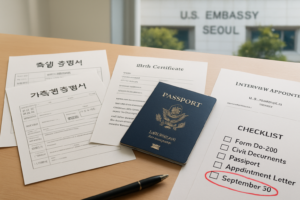
If you are searching for DV-2026 September 30 deadline documents translation, you are likely in the most stressful part of the Diversity Visa process: the final stretch where timing matters as much as accuracy. For Korean applicants, the problem is rarely just getting documents—it is making sure the right Korean records are newly issued when needed, translated into clear English, and carried in a way that does not create avoidable delays at the interview.
DV-2026 visas cannot be issued after September 30, 2026. That means even a small document problem can become a serious issue if your case is scheduled late or your visa number becomes current close to the deadline. The safest approach is to review your civil records now, reissue anything that may be outdated or damaged, and confirm that your English translations match the Korean originals exactly.
Why the September 30 cutoff changes how Korean applicants should prepare
The Diversity Visa program is unforgiving about deadlines. Unlike some other immigration processes, there is no flexibility once the fiscal-year deadline passes, even if your case was otherwise approvable.
That is why late-stage document preparation is risky. If Embassy Seoul requests clarification, if a family record does not clearly show the relationship, or if a translation contains a name mismatch, you may lose precious time that cannot be recovered after September 30.
What “ready” should mean for DV-2026 cases
Being ready is not just having scans on your phone or old copies in a folder. For high-stakes certified translation for diversity visa preparation, you should have current originals or official reissues, complete English translations, and a neatly organized interview set that can be reviewed quickly.
- Check whether each civil record is legible and recently issued
- Make sure names, birth dates, and registration details match your passport and case file
- Prepare English translations for any Korean-language document you will present
- Carry both the Korean original and the English translation to the interview
- Separate principal applicant documents from spouse and child documents
This is especially important if your family composition changed after entry, if you have used different Romanization spellings, or if your records contain annotations that are easy to mistranslate.
Which Korean civil records should be reissued before the interview
Many Korean applicants assume older printouts are good enough because the facts have not changed. In practice, fresh copies are often easier to read, more complete, and less likely to trigger questions about whether the record reflects your current legal status.
Embassy Seoul DV interview documents: core civil record checklist
For Embassy Seoul DV interview documents, the exact set can vary by case, but Korean applicants commonly prepare the following civil records for themselves and any derivative family members:
| Document | Why it matters | Best practice |
|---|---|---|
| Basic Certificate | Shows core identity information | Obtain a clean recent issue and translate fully |
| Family Relation Certificate | Shows parent-child or spouse relationships | Use a current version with all relevant details visible |
| Marriage-related record if applicable | Supports current marital status | Reissue if older copy is unclear or incomplete |
| Divorce-related record if applicable | Documents termination of prior marriage | Translate all entries and dates carefully |
| Adoption or custody records if applicable | Clarifies legal relationship to a child | Do not rely on partial or informal copies |
If you have children immigrating with you, the relationship documents must be especially clear. If a record is faded, cropped, or missing pages, reissue it rather than hoping the officer will overlook the defect.
Korean family relation certificate translation: common issues
A Korean family relation certificate translation often looks simple until small details become important. Relationship labels, registration notes, and names of parents or spouse must be translated consistently with the rest of your file.
Problems often arise when one document uses a passport spelling and another uses a different Romanization. If “Gyeong-su” appears elsewhere as “Kyungsoo,” your translation should not create confusion. Accuracy and consistency matter more than making the English look elegant.
Korean basic certificate English translation: what to watch closely
A Korean basic certificate English translation should reflect the full content of the Korean record, not just the parts you think the embassy will care about. Omitting legal notations, issue details, or status entries can create questions about whether the translation is complete.
Make sure the translator preserves names, dates, registration data, and any remarks exactly. If a record includes historical or administrative notes, they should generally be translated rather than ignored.
How to handle English translations without creating last-minute delays
For DV cases, translation quality is not a cosmetic issue. A poor translation can make a valid document unusable because the officer cannot confidently connect it to your identity, family relationship, or eligibility history.
Certified translation for diversity visa cases: what “good” looks like
A strong certified translation for diversity visa purposes is complete, readable, and faithful to the Korean source document. It should not summarize, paraphrase, or guess at unclear handwriting or cut-off text.
At a practical level, your translation set should include the full English rendering of each Korean document and a translator certification statement where appropriate. The translation should also preserve formatting logic so the officer can compare the English text against the original Korean record without struggling.
- Translate every visible field, stamp, notation, and remark that may affect identity or family status
- Keep spellings consistent across all translated documents
- Use the passport spelling of names whenever possible for alignment
- Do not mix machine translation output with unreviewed human edits
- Check dates carefully, especially where Korean formatting may be misread
If one family member’s document was translated by a different provider, compare terminology before the interview packet is finalized. Inconsistent wording across family records can create avoidable questions.
What to carry on interview day so document issues do not waste your final window
By the time your interview arrives, your goal is speed and clarity. You do not want to search through a phone gallery, open email attachments at the window, or explain why one page is missing from a translated record.
Build a simple interview folder system
Use a physical folder with sections for the principal applicant, spouse, and each child. Place each Korean original directly behind its English translation so the pair can be reviewed together.
Label your packet in a way that reduces stress. A clean document order can make your interaction more efficient and help you catch missing items before you leave home.
- Passport and appointment-related papers
- Civil records in Korean originals or official copies
- English translations for each Korean-language document
- Relationship records for spouse and children
- Any prior-marriage termination records if relevant
- Extra photocopies for your own backup
When to reissue documents again before the interview
If your interview is scheduled much later than expected, review whether any record should be freshly reissued for clarity or completeness. This is especially sensible if your earlier copy was printed many months ago, has light text, or was obtained before a family-status update was reflected.
For applicants close to the fiscal-year end, reducing uncertainty is worth the extra effort. The closer you are to September 30, the less room you have for a second trip, a correction request, or a translation redo.
Frequently Asked Questions
Do all Korean civil records for a DV interview need English translation?
Any Korean-language civil record you plan to submit or present should be translated into English so the consular officer can review it clearly. The safest practice is to bring both the Korean original or official copy and the complete English translation together.
Should I reissue my Korean family and basic certificates if I already have older copies?
If your existing copies are old, hard to read, incomplete, or no longer reflect your current family situation, reissuing them is usually the safer choice. Freshly issued records can reduce confusion and help avoid delays during final DV-2026 processing.
What is the biggest translation mistake Korean DV applicants make before September 30?
The most common high-risk mistake is inconsistency: names, dates, and relationship details do not match across the passport, application records, and translated civil documents. Near the September 30 deadline, even a small mismatch can cost time you may not have.
The final weeks of DV-2026 are not the time to gamble on old paperwork or rushed translations. If your case may move late, focus on what you can still control: current Korean civil records, accurate English translations, and a well-organized interview file.
A calm, methodical document review now can prevent the kind of last-minute issue that becomes impossible to fix once the fiscal-year deadline arrives. For Korean applicants, preparation is not just helpful—it is the margin that can keep a valid case moving before time runs out.