Embassy Seoul Immigrant Visa Papers 2026: The Korean Records You Must Reissue, Translate, and Bring
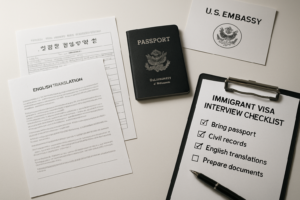
If you are searching for the U.S. Embassy Seoul immigrant visa document checklist 2026, the biggest mistake to avoid is assuming any old Korean certificate will do. At immigrant visa interviews, applicants are often delayed not because they forgot a document entirely, but because the record is outdated, incomplete, untranslated, or does not match the case file.
For Korean civil documents, details matter. A certificate issued years ago, a short-form family record, or a translation that omits annotations can trigger same-day document requests and push your case into administrative follow-up. The goal is simple: bring fresh, legible, complete Korean records with accurate English translations and consistent names across every document.
What Embassy Seoul Usually Expects for Korean Civil Records in 2026
For immigrant visa processing, the embassy is not just checking identity. Officers compare your Korean civil records against the petition, DS-260, National Visa Center submissions, police records, and relationship evidence. Any mismatch can slow approval.
As a practical rule, applicants should carry original or officially issued Korean civil records, plus English translations where required, even if scans were already uploaded earlier in the process. It is also wise to reissue key records shortly before the interview so they reflect the most current status.
Embassy Seoul visa interview documents: the core Korean records
The exact list depends on the visa category, but many applicants should review these Korean documents before interview day:
- Basic Certificate
- Family Relation Certificate
- Marriage Relation Certificate
- Certificate of Divorce or updated marriage-related record, if applicable
- Adoption-related records, if applicable
- Korean police certificate, if required for the case
- Passport and any prior identity documents relevant to name changes
Not every applicant needs every record. However, family-based immigrant visa cases commonly require close review of identity, parent-child relationship, marriage history, and prior marital status. That is why short or incomplete versions of Korean family records can become a problem.
| Document | Why It Matters | Common Risk |
|---|---|---|
| Basic Certificate | Shows core identity details and personal status information | Old issue date or incomplete translation |
| Family Relation Certificate | Confirms parent-child and family relationships | Submitting a version that lacks needed details |
| Marriage Relation Certificate | Shows current and prior marriage history | Missing entries, divorce history, or annotations in translation |
| Police Certificate | Used for admissibility review | Name mismatch with passport or visa file |
Which Korean Certificates Should Be Newly Issued Before the Interview
One of the safest ways to prepare for the U.S. Embassy Seoul immigrant visa document checklist 2026 is to obtain recent copies of your main civil records. Even if an older version was accepted at an earlier stage, a newly issued certificate reduces the chance that the embassy sees stale information.
This is especially important if anything changed after NVC submission, such as marriage, divorce, child birth, legal name updates, corrections to the family registry, or address-related administrative updates that affect linked records.
Korean Basic Certificate translation: when a fresh issue is the smart choice
Your Basic Certificate is often treated as a foundational identity record. If your existing copy is old, damaged, partly unreadable, or was translated long ago, order a new one and have that specific version translated.
Translations should reflect the exact certificate you are carrying. If the Korean original has marginal notes, corrected entries, or status-related remarks, those should not be silently omitted in English.
Family Relation Certificate detailed translation: why the detailed version matters
For many immigrant visa cases, a Family Relation Certificate detailed translation is more useful than a minimal or simplified version. The point is not just to show that family members exist. The embassy may need to see enough detail to confirm the claimed legal relationship clearly.
If the petition depends on proving a parent-child link, derivative child status, or family composition, a detailed version can help avoid follow-up requests. When in doubt, applicants often benefit from carrying the fuller record rather than the shortest available printout.
Marriage Relation Certificate English translation: do not overlook prior history
A Marriage Relation Certificate English translation should accurately reflect current marital status and any recorded prior marriage events. This matters in CR1, IR1, F-category, and derivative cases because officers frequently compare relationship timelines across the petition, civil records, and interview answers.
If a divorce, remarriage, annulment, or correction appears on the Korean record, the translation should capture it clearly. A translation that only summarizes the current marriage while ignoring recorded history can create avoidable questions.
How to Translate Korean Civil Records Without Creating New Problems
Translation errors can be just as damaging as missing documents. The embassy officer may not have time to decode inconsistent romanization, partial translations, or unexplained omissions. Your documents should be easy to compare at a glance.
The most common issues are name mismatches, omitted annotations, inconsistent date formatting, and translations that do not match the exact document version presented at interview.
Name consistency across passport, petition, and certificates
Your English name should appear consistently across the passport, immigrant visa case, and translated Korean records. If your family registry document uses one romanization and your passport uses another, that does not always mean the record is invalid, but it should be handled carefully and consistently.
Dates should also be standardized. If one document uses year-month-day order and another translation flips the order carelessly, confusion can result, especially where marriage or birth timing affects eligibility.
What a complete translation should cover
A reliable English translation of Korean civil records should generally include:
- All visible names and aliases
- Birth dates and registration details
- Relationship labels such as father, mother, spouse, child
- Issue date of the certificate
- Recorded status changes, corrections, and annotations
- Official headings, seals, and identifying reference numbers where relevant
If a document appears to contain extra notes that seem administrative or minor, do not assume they can be skipped. Small notations sometimes answer the exact question a consular officer is reviewing.
Interview-Day Checklist to Reduce 221(g) Delays and Resubmission Requests
By the time you attend the interview, your file should be organized for quick review. The best-prepared applicants separate originals, copies, and translations so they can hand over each item immediately when asked.
This is where the Embassy Seoul visa interview documents process becomes practical rather than theoretical. A clean document set can save time, reduce stress, and prevent a same-day request to submit additional records later.
Carry these in a clear, interview-ready set
- Current passport
- Interview appointment letter
- DS-260 confirmation page
- Recently issued Korean civil records relevant to your case
- English translations matching each Korean original
- Any prior divorce, death, or adoption records if applicable
- Police certificate and other required supporting records
- A backup copy set for your own reference
Review your documents as a timeline. Birth, marriage, divorce, child birth, and name history should make sense from one record to the next. If something looks inconsistent to you before the interview, it will likely look inconsistent to the officer as well.
Also remember that uploading documents to NVC does not always eliminate the need to bring them physically. For the U.S. Embassy Seoul immigrant visa document checklist 2026, carrying the originals and their English translations remains the safer approach.
Frequently Asked Questions
Do I need newly issued Korean civil records if I already uploaded documents to NVC?
In many cases, bringing recently issued records is the safer choice, especially if your older documents were issued long before the interview or if any personal status changed. The embassy may want to see current originals that match the translations and reflect your latest legal record.
Does every Korean certificate need an English translation for an immigrant visa interview in Seoul?
If the document is in Korean and will be reviewed as part of your immigrant visa eligibility, an English translation is generally the prudent approach. The translation should match the exact certificate you present and should fully reflect the content, including important annotations or status changes.
What Korean civil record causes the most avoidable interview delay?
There is no single document in every case, but incomplete family or marriage records are frequent trouble spots. A Family Relation Certificate detailed translation or a complete Marriage Relation Certificate English translation often makes the relationship history easier for the officer to verify without requesting additional submissions.
Preparing for an immigrant visa interview in Seoul is less about collecting random paperwork and more about presenting a coherent legal record. Freshly issued Korean certificates, complete English translations, and consistent names across all documents can make the difference between a smooth interview and a preventable delay.
Before your appointment, review each record as if you were the officer seeing it for the first time. If the document is current, complete, and clearly translated, you give your case the best chance of moving forward without unnecessary resubmission.